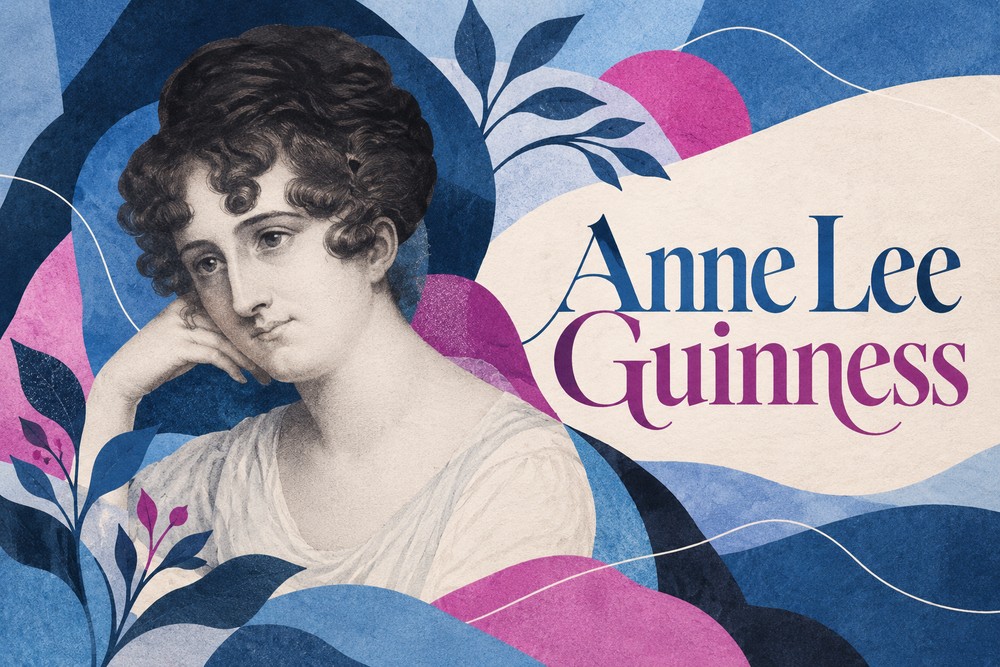
A Childhood Beside a Cathedral Under Repair
I begin on 11 June 1839 in Dublin, where Anne Lee Guinness was born, the only daughter among the children of Sir Benjamin Lee Guinness, 1st Baronet, and his wife Elizabeth. Her father, a brewer of enormous wealth, spent a portion of it restoring St Patrick’s Cathedral. While the scaffolding climbed the nave, his daughter looked outward rather than upward, sponsoring Bible readings and paying for basic medical relief among the poor who lived in the cathedral’s shadow.
Anne never held an office or signed a brewery ledger. Her instruments were subscriptions, visits, and quiet arrangements. She was a gardener of small institutions, planting where she stood.
A Wedding on Her Birthday
On 11 June 1863, her twenty fourth birthday, Anne married William Conyngham Plunket, a Church of Ireland clergyman born in 1828. He became Bishop of Meath, then Archbishop of Dublin from 1884 until 1897. In 1871 he succeeded to the barony, and Anne became Baroness Plunket of Newton.
The match joined two currents of Irish life, the brewing fortune of St James’s Gate and the ecclesiastical leadership of the established church. Anne brought roughly 49,000 pounds into the marriage, a sum often described as about 6 million pounds in present value. The money went into Old Connaught House, extending the house and restoring its walled garden. I picture that garden as her first project, a bounded patch of order carved out of a large inheritance.
Six Children and a Widening Family Tree
The couple had six children, two sons and four daughters. William Lee Plunket, born in December 1864, became the 5th Baron Plunket, a diplomat, and Governor of New Zealand from 1904 to 1910. Elizabeth Charlotte followed in 1868 and died unmarried in 1914. Benjamin John, born at Bray in 1870, was ordained in 1896 and served as Bishop of Tuam, Killala and Achonry, then Bishop of Meath. He resigned for health reasons and died in 1947. Olivia Anne, born in 1873, died at 23. Kathleen Louisa, born in 1877, married Sir Reginald Dawson-Damer, 6th Baronet. Ethel Josephine, born in 1879, married Major William Nicholson, 2nd Baronet.
Her siblings shaped the Guinness story just as strongly. Arthur Edward Guinness, born in 1840, became 1st Baron Ardilaun. Captain Benjamin Lee Guinness II, born in 1842, served in the Royal Horse Guards. Edward Cecil Guinness, born in 1847, became 1st Earl of Iveagh. When Sir Benjamin died on 19 May 1868, control of the brewery passed to Arthur and Edward, while Anne and her younger brother Benjamin received estates and funds.
I have seen the claim that Anne was disinherited. The record does not support so clean a story. She received property and money, but no share of brewery ownership.
The Nursing Home and the Schools
In 1876 Anne founded St Patrick’s nursing home in Dublin, a training centre for Church of Ireland nurses that also provided free care to the needy. The institution outlasted her by generations, a stone thrown into water whose rings kept spreading.
Education drew her as well. She helped expand Alexandra College, a girls’ school in Dublin, and founded the Irish Clergy Daughters’ School at Earlsfort Terrace, a place for the daughters of Church of Ireland clergymen. Each required money, committees, and persistence, the unglamorous machinery of philanthropy.
For much of her life Anne lived with a degenerative illness. She died on 8 November 1889 at Old Connaught House at only 50 and was buried in the Guinness family vault at Mount Jerome Cemetery. In St Patrick’s Cathedral, stained glass windows depicting Dorcas commemorate her charity. Dorcas, the biblical woman who made garments for the poor, is a fitting mirror for a woman who clothed need in practical forms.
The Next Generation and a Famous Crash
Through her eldest son, the line reached public prominence. Genealogical accounts list Terence Conyngham Plunket, who became 6th Baron Plunket, and his brother Brinsley, an RAF flight lieutenant who died in Sudan in 1941. Terence and his wife were killed in a 1938 plane crash, and their three young sons, Patrick, Robin, and Shaun, were raised by his sister Helen.
| Year | Event |
|---|---|
| 1839 | Born in Dublin on 11 June |
| 1863 | Marries William Plunket on 11 June |
| 1876 | Founds St Patrick’s nursing home |
| 1884 | Husband becomes Archbishop of Dublin |
| 1889 | Dies on 8 November at Old Connaught House |
| 2025 | Portrayed in a television drama about the Guinness family |
The Modern Spotlight
A 2025 television drama about the Guinness family brought Anne back into view, with Emily Fairn playing her. A wealthy Victorian daughter who spends her dowry on nurses and schoolgirls is a better story than a passive heiress, and the drama’s fictional romance belongs to fiction rather than to her life. What survives the scrutiny is the nursing home, the schools, the dowry turned to brick and garden, and the glass in the cathedral.
FAQ
When was Anne Lee Guinness born and when did she die?
She was born on 11 June 1839 in Dublin and died on 8 November 1889 at Old Connaught House, aged 50. She was buried in the Guinness family vault at Mount Jerome Cemetery.
Who was her husband?
William Conyngham Plunket, 4th Baron Plunket, a Church of Ireland clergyman who became Archbishop of Dublin from 1884 to 1897. They married on 11 June 1863.
How many children did she have?
Six, two sons and four daughters.
Did she inherit part of the Guinness brewery?
No. The brewery passed to her brothers Arthur and Edward. Anne received estates and funds, plus a marriage dowry of about 49,000 pounds, and she was not disinherited, but she held no ownership stake in the business.
What institutions did she found or support?
She founded St Patrick’s nursing home in 1876 and the Irish Clergy Daughters’ School at Earlsfort Terrace, and she supported the expansion of Alexandra College. Dorcas stained glass windows in St Patrick’s Cathedral commemorate her.