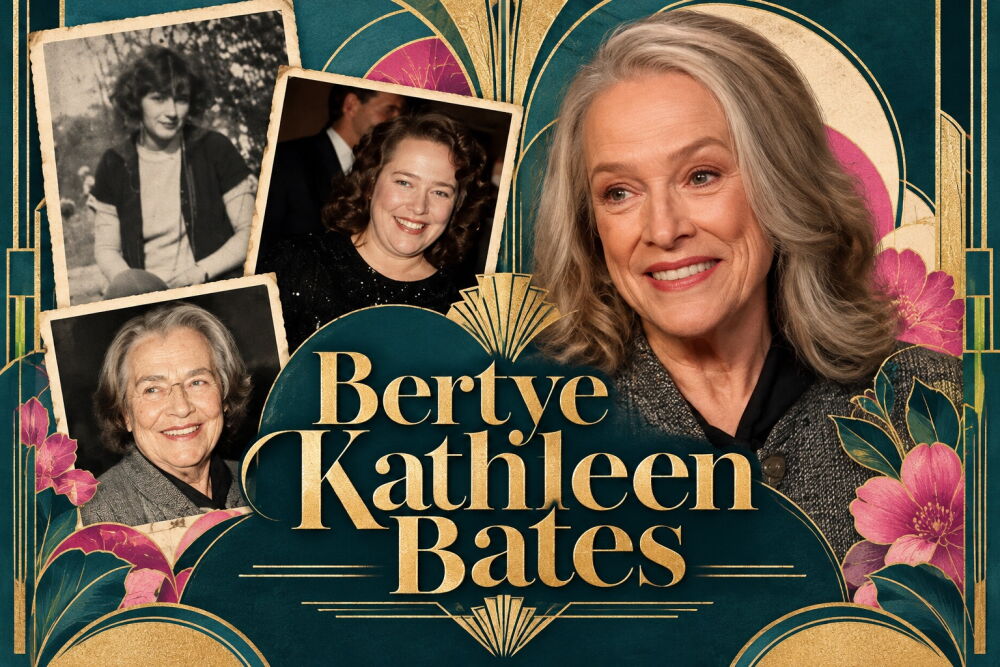
A Southern Life With More Than One Dimension
Bertye Kathleen Bates loved genealogy, flowers, music, needlework, poetry, and travel. She raised three daughters in Memphis and later moved to California, where her youngest, Kathy Bates, became an Academy Award winning actress. Her family called her Mimi.
I find that range of interests a better introduction than a celebrity parent label alone. Bertye’s life included preservation work, civic organizations, and a distinctive sense of humor. She could be conservative and unconventional at once, resisting the tidy categories people sometimes place around an older Southern woman.
Born Bertye Kathleen Talbert, she was associated with McCormick, South Carolina. January 26, 1907, is her recorded birth date. Some accounts describe the birthplace as Edgefield, reflecting an unresolved geographical variation in the family history.
Marriage and the Memphis Household
Bertye married Langdon Doyle Bates, a mechanical engineer from Tennessee. Their marriage is commonly dated to 1932, although that year is less firmly established than their family relationship.
By 1940, they were living in Memphis with daughters Patricia and Mary. Langdon’s widowed mother, Madge Doyle Bates, was also part of the household. Kathy had not yet been born.
Their youngest daughter arrived on June 28, 1948, and was named Kathleen Doyle Bates. The long interval between the older girls and Kathy gives the family timeline a shape easily missed in short celebrity biographies.
Langdon’s father, Finis L. Bates, was a lawyer and author. He was Bertye’s father in law, rather than an ancestor from her own Talbert line. I like to keep those branches distinct because familiar surnames can otherwise pull several generations into one blurred family tree.
| Family member | Relationship to Bertye |
|---|---|
| Langdon Doyle Bates | Husband |
| Patricia Smith | Eldest daughter |
| Mary Bates Wehbi | Daughter |
| Kathleen Doyle Bates | Youngest daughter, known as Kathy |
| Madge Doyle Bates | Mother in law |
| Finis L. Bates | Father in law |
Genealogy Gardens and Historic Preservation
Bertye’s public work was largely civic and cultural. She was a charter member of the Tennessee Genealogical Society and served as regent of the Fort Assumption Chapter of the Daughters of the American Revolution.
She also belonged to the Daughters of the American Colonists and held leadership roles in the Josephine Circle and Garden Study Club. Her preservation interests included activity during the restoration of the Fontaine House in Memphis.
To me, those details suggest sustained participation rather than a passing hobby. Genealogy asks people to trace names through time; preservation asks them to protect the places those names inhabited. Bertye invested attention in both.
Her love of flowers and needlework adds another scale to that work. A restored historic building and a carefully tended garden are different undertakings, but each involves patience and an eye for what might otherwise be neglected.
Three Daughters With Different Public Lives
Patricia later used the surname Smith. Mary became Mary Bates Wehbi, with her husband identified as George. Their professional and personal histories are far less public than Kathy’s, and further details are not established.
Kathy studied theatre at Southern Methodist University, graduating in 1969. She then moved to New York and built a stage career before becoming widely known on film and television.
Her parents helped pay for that education. Kathy later remembered the sacrifices involved, including delayed retirement. Those recollections describe a family’s effort, rather than proving a particular household income or level of wealth.
Kathy’s marriage to actor Tony Campisi lasted from 1991 until 1997. Bertye’s death occurred in the same year as that divorce, placing more than one major personal change within a short period of her daughter’s life.
Misery and a Mother’s Dry Response
On November 29, 1990, Bertye attended the Los Angeles premiere of Misery with Kathy. The film transformed Kathy’s screen career, and her performance as Annie Wilkes won the Best Actress Oscar the following year.
Bertye’s remembered response cut through the excitement: her daughter had not discovered a cure for cancer. The remark conveys dry humor without explaining their entire relationship. Kathy has acknowledged both affection and difficulties between them.
For years, Kathy believed she had failed to thank her mother in the Oscar speech. In 2024, watching the recording, she discovered that she had thanked her mother at home after all. Her visible relief made an old family memory newly immediate.
I find that episode poignant because memory can preserve guilt more firmly than the event itself. The recording supplied a small correction to something Kathy had carried for decades.
California and Her Final Years
Bertye spent approximately her last decade in California. Langdon died in 1989. She survived him until February 15, 1997, dying in Culver City after a long illness at 90.
Her survivors included three daughters and five grandchildren. The grandchildren were not individually named in the established family account. Her interment was private, and the precise burial details remain uncertain.
No personal net worth, estate value, or salaried career is publicly established for her. I would remember the work that is documented: raising a family, supporting education, studying ancestry, and helping care for Memphis’s cultural heritage.
FAQ
Who was Bertye Kathleen Bates?
She was Kathy Bates’s mother, a Memphis homemaker with active interests in genealogy, gardening, and historic preservation.
What was her maiden name?
Her maiden name was Talbert. Talbot also appears as a recurring spelling variation.
How many children did she have?
She had three daughters: Patricia, Mary, and Kathleen, known professionally as Kathy Bates.
When did she die?
She died on February 15, 1997, in Culver City, California, aged 90, after a long illness.
Did Kathy thank her at the Oscars?
Yes. The recording of Kathy’s 1991 acceptance speech includes thanks to her mother, something Kathy rediscovered with relief in 2024.